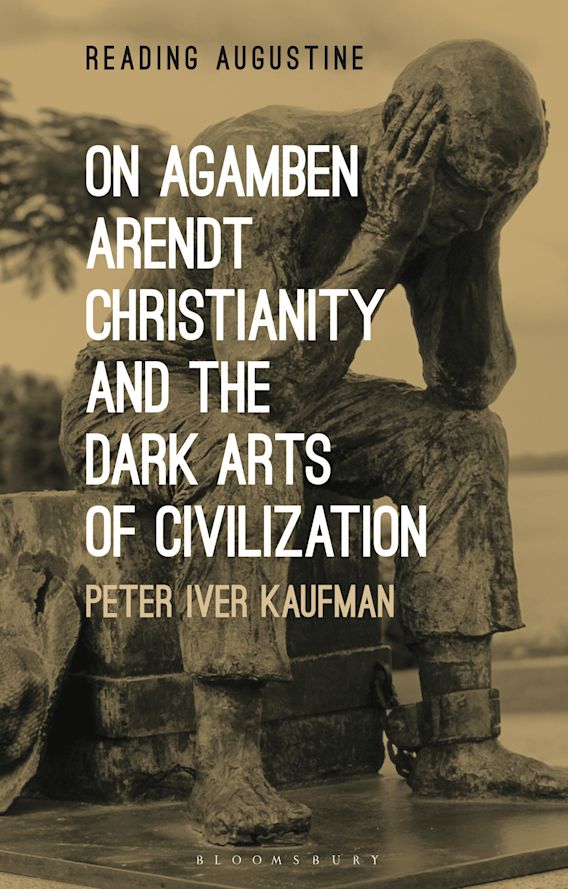
2019 – Many progressives have found passages in Augustine’s work that suggest he entertained hopes for meaningful political melioration in his time. They also propose that his “political theology” could be an especially valuable resource for “an ethics of democratic citizenship” or for “hopeful citizenship” in our times. Peter Kaufman argues that Augustine’s “political theology” offers a compelling, radical alternative to progressive politics. He chronicles Augustine’s experiments with alternative polities, and pairs Augustine’s criticisms of political culture with those of Giorgio Agamben and Hannah Arendt.
This book argues that the perspectives of pilgrims (Augustine), refugees (Agamben), and pariahs (Arendt) are better staging areas than the perspectives and virtues associated with citizenship-and better for activists interested in genuine political innovation rather than renovation. Kaufman revises the political legacy of Augustine, aiming to influence interdisciplinary conversations among scholars of late antiquity and twenty-first century political theorists, ethicists, and practitioners.
John Cavadini, Notre Dame: The genius of this book lies in its invitational style. It forces nothing on Augustine, and does not force Augustine on anyone, and is explicit about the ways in which the comparisons to which it invites us reveal differences too. It places the reader under no constraints. It precisely – and persuasively – invites the reader to consider a similarity in style and tone of thought among the three writers it discusses. In particular, to consider that they shared in common a paradoxical perspective on political culture as, on the one hand, a sine qua non for the existence of civilization, and yet, on the other, a set of “dark arts,” its necessity notwithstanding. . . . I love this kind of book, able to make provocative and truly fruitful comparisons across the ages, resisting the historical positivism that would put Augustine (e.g.) in his place and only in his place. This kind of humane scholarship is certainly rarer nowadays. Kaufman exercises it in a magnificent and compelling fashion.
Alden Bass: “Kaufman’s apocalyptic and communitarian Augustine is a helpful corrective to the dominant view.”
 Peter Iver Kaufman