June 30, 2025 – This book investigates how Arendt’s disillusionment with the limits of political participation should influence our responses to contemporary crises of democracy. It draws on Arendt’s embracement of freedom, plurality, critique, agonistic exchanges, natality, equality and the virtuosity of citizen-statesmen to consider how she might help us to reinvigorate democracy at a time of eroded trust in political institutions. The book suggests that Arendt’s experience in Europe, her increasing anxieties about the trajectory of American democracy, and her consistent preferences for opinion and innovation are a rejoinder to politics-as-usual in the present.
Jana Mader, Bard College: “Kaufman reinvigorates Arendt’s thought to offer a bold reimagining of democracy for our age. Through insightful critique and passionate scholarship, this work challenges readers to embrace citizenship anew, pushing beyond disillusionment to realize Arendt’s enduring vision of freedom and collective responsibility in a fractured political landscape. Essential for our times!”
2024 – Late Roman Africa gives us plenty to ponder. Christianity there had been divided between two factions since the early fourth century. By the fifth, militants among the Donatists (or sectarians) struck at their rivals, whose leading spokesman, Augustine, is our principal source. But did he exaggerate the difficulties catholic Christianity faced or wholly fabricate to attract government attention and intervention? For the same purposes, did he invent a resurgence of paganism? Or were there dangers to the safety of his congregations from sectarians and complications caused by polytheists purveying fake news about the history and fate of the empire? Did their seductive fictions threaten the ascendancy of Christianity, which its most prolific prelate would have been irresponsible to overlook? The scholarly consensus now tilts toward the claim that Augustine deployed the rhetoric of security to “wipe out” Donatists and pagan dissent. Some suggest the latter was then extinct. Safety First contends that Augustine’s concerns were well-founded and that his attempts to redirect civic philanthropy, reconcile with sectarian Christians, end idolatry, and draw support for those efforts from the politically influential expressed his interests in security and adapted what his faith considered sound perspectives on sin, the sacraments, sacrilege, and superstition.
Ian Clausen, editor-in-chief, Augustinian Studies: It is no surprise that Peter Kaufman, long a thrilling and dissident voice in the field of Augustine’s political thought, has once again challenged us to reconsider our prevailing assumptions about the late antique world. His book’s unassuming title disguises a deep engagement with Augustine’s difficult balancing act between Christian misericordia and Roman imperium, issuing its own balanced assessment of the bishop’s efforts to support the conditions of earthly life as a member of the catholic faithful. This is an impressive achievement.
2021 – Peter Iver Kaufman shows that, although Giorgio Agamben represents Augustine as an admired pioneer of an alternative form of life, he also considers Augustine an obstacle keeping readers from discovering their potential. Kaufman develops a compelling, radical alternative to progressive politics by continuing the line of thought he introduced in On Agamben, Arendt, Christianity, and the Dark Arts of Civilization.
Kaufman starts with a comparison of Agamben and Augustine’s projects, both of which challenge reigning concepts of citizenship. He argues that Agamben, troubled by Augustine’s opposition to Donatists and Pelagians, failed to forge links between his own redefinitions of authenticity and “the coming community” and the bishop’s understandings of grace, community, and compassion. On Agamben, Donatism, Pelagianism, and the Missing Links sheds new light on Augustine’s “political theology,” introducing ways it can be used as a resource for alternative polities while supplementing Agamben’s scholarship and scholarship on Agamben.
Ward Blanton, University of Kent, Canterbury, UK: Kaufman’s analyses take us back in time – but also strangely back to ourselves – in the name of a vexed and even traumatic desire for political alternatives. In this journey Kaufman shows himself to be the historian of Christianity able to send vivifying shock waves through the many contemporary discussions of political theology in critical theory and continental philosophy. No one who attends to Kaufman’s Augustine will ever see Agamben – or indeed their own political situation – in the same way again.
2019 – Many progressives have found passages in Augustine’s work that suggest he entertained hopes for meaningful political melioration in his time. They also propose that his “political theology” could be an especially valuable resource for “an ethics of democratic citizenship” or for “hopeful citizenship” in our times. Peter Kaufman argues that Augustine’s “political theology” offers a compelling, radical alternative to progressive politics. He chronicles Augustine’s experiments with alternative polities, and pairs Augustine’s criticisms of political culture with those of Giorgio Agamben and Hannah Arendt.
This book argues that the perspectives of pilgrims (Augustine), refugees (Agamben), and pariahs (Arendt) are better staging areas than the perspectives and virtues associated with citizenship-and better for activists interested in genuine political innovation rather than renovation. Kaufman revises the political legacy of Augustine, aiming to influence interdisciplinary conversations among scholars of late antiquity and twenty-first century political theorists, ethicists, and practitioners.
John Cavadini, Notre Dame: The genius of this book lies in its invitational style. It forces nothing on Augustine, and does not force Augustine on anyone, and is explicit about the ways in which the comparisons to which it invites us reveal differences too. It places the reader under no constraints. It precisely – and persuasively – invites the reader to consider a similarity in style and tone of thought among the three writers it discusses. In particular, to consider that they shared in common a paradoxical perspective on political culture as, on the one hand, a sine qua non for the existence of civilization, and yet, on the other, a set of “dark arts,” its necessity notwithstanding. . . . I love this kind of book, able to make provocative and truly fruitful comparisons across the ages, resisting the historical positivism that would put Augustine (e.g.) in his place and only in his place. This kind of humane scholarship is certainly rarer nowadays. Kaufman exercises it in a magnificent and compelling fashion.
Alden Bass: “Kaufman’s apocalyptic and communitarian Augustine is a helpful corrective to the dominant view.”
2017 – In Augustine’s Leaders, Peter Iver Kaufman works from the premise that appropriations of Augustine endorsing contemporary liberal efforts to mix piety and politics are mistaken–that Augustine was skeptical about the prospects for involving Christianity in meaningful political change. His skepticism raises several questions for historians. What roles did one of the most influential Christian theologians set for religious and political leaders? What expectations did he have for emperors, statesmen, bishops, and pastors? What obstacles did he presume they would face? And what pastoral, polemical, and political challenges shaped Augustine’s expectations–and frustrations? Augustine’s Leaders answers those questions and underscores the leadership its subject provided as he continued to commend humility and compassion in religious and political cultures that seemed to him to reward, above all, celebrity and self-interest.
Charles Mathewes, University of Virginia: A lucid, powerful, and deeply thoughtful work. Kaufman takes a very skeptical historian’s view of the proposals of several contemporary thinkers, myself included, on Augustine and politics. He is equally frank about those disagreements and charitable with those whose views he critiques. But the book rises above critique; it distills decades of careful linguistic and historical scholarship, and offers a compelling vision of Augustine’s understanding of the relation between Christianity and ‘worldly’ activism. I may stubbornly disagree with (parts of) Kaufman’s interpretation, but I learned a tremendous amount from this book, both to my edification and my correction; and the next time I teach anything about Augustine and politics, it will be required reading.
2007 – Augustine in the fourth and fifth centuries and Thomas More in the sixteenth were familiar with the deceits and illusions that enabled even the most vile rulers to shore up their dignity and that gave repressive regimes an inviolability of sorts. Both men knew the politics of their times, both were involved in politics, and both were at one time politically ambitious. Augustine needed and made good use of government’s powers of coercion and damage control in his struggle against the Donatists. The clear advantages of political protection and correction preoccupied More in his battle against Martin Luther. Both later changed their minds and believed, finally, the political imagination, based as it is on a desire for power, always and inevitably leads to devastation and suffering. Peter Iver Kaufman explains how and why we have failed to appreciate Augustine’s and More’s profound political pessimism, reintroducing readers to two of the Christian tradition’s most enigmatic yet influential figures. Each had been disturbed by the reach of his own political ambitions—as by those of contemporaries. Each knew that government was useful—yet always deceitful. And each wrote a classic—widely read to this day, Augustine’s City of God and More’s Utopia,as well as abundant correspondence and polemical tracts to explain why government on earth might be used, though never meaningfully improved.
Kevin Madigan, Harvard University Divinity School: “Peter Iver Kaufman is admirably and ideally qualified to undertake this project of reading More on politics in the light of Augustine on politics. In vigorous, well-paced prose, he tackles an important and original subject.”
Marcia L. Colish, Frederick B. Artz Professor Emerita of History, Oberlin College: “Incorrectly Political will attract readers not only because it is written with the author’s characteristic flair and liveliness, but also because of his established capacity to bridge centuries of Western thought and history. Written at the dawn of the new century, this book acquires deep resonance from the events unfolding around the world, circumstances to which Augustine’s and More’s complex thoughts on political possibility still speak. If ever a study of such hoary figures from the Christian past deserved the label ‘timely,’ it is surely this one.”
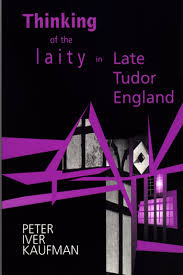
2004 –Historians are usually more intrigued by what was than by what might have been. It is not surprising, then, that a relatively tame Elizabethan puritanism has been deposited in the mainstream of English Protestantism while some radical schemes, or what Peter Kaufman refers to as the “what might have been,” are more or less overlooked. Thinking of the Laity features fresh evidence that the advocates of broadly participatory parish regimes publicly confronted their critics. It collects shards of the expectations and regrets that survive in a few petitions, in manuscript records of university controversy, and in the recollections of proponents of lay and local control. Kaufman argues that to assemble these fragments is to find forgotten moments in the Elizabethan polity debates and to recover thinking about the laity that gave “revolutionary force” to late Tudor puritanism.
Elizabethan reformers, especially the most “forward,” outspoken puritans, accused English Catholics of “expound[ing] ecclesia to be a state opposite unto, and severed from the laitie.” Kaufman’s study concentrates on the identity and aspirations of these reformers who sought to remedy the “severing” of the church from its people by instituting the extraordinarily controversial solution of broadly participatory parish regimes. Reformers recommended lay involvement in parish elections and in disciplining deliquents. Opponents of the reformers perceived the participatory initiatives as a threat to order and clerical authority, and opposed experiments with laicization, democratization, and local control. By the late 1580s the Puritans had lost their fight, but the debate was both lively and public, and as Kaufman deftly and persuasively reminds us, the roads not taken are still important parts of the historic landscape.
Thinking of the Laity explains why proposals for expanding lay prerogatives failed to shape the Elizabethan religious settlement from the 1560s through the 1580s. It also greatly adds to our understanding of the policy debates that are closely associated with the origins of puritanism, presbyterianism, and congregationalism. This book will be essential reading for people interested in the history of early modern England and in the progress of sixteenth-century religious reform.
“A fine and timely book . . . Kaufman’s work reminds us that we can confidently claim that the sixteenth-century English reformed tradition had truly popular appeal.” —Lori Anne Ferrell, Claremont Graduate University
“As usual, Peter Kaufman has asked a question that opens new vistas for historians of the English Reformation. This book will have an important impact on the ways we think about the development of popular Protestantism in England, as well as our understanding of Elizabethan politics.” —Norman Jones, Prof. & Chair of History, Utah State University, author of The English Reformation: Religion and Cultural Adaptation
“Peter Kaufman shows that some of the early English Protestants, appealing to the primitive Church, came out openly in favour of lay participation. On the whole, however, the attitude was ambivalent.” —Heythrop Journal
“Thinking of the Laity. . . examines the hopes and schemes of advocates of greater local and lay control over the Elizabethan Church, and attempts to account for their ultimate failure. This is a line of thought that Kaufman traces from Lollardy and the early Reformation through the activities of ‘stranger’ churches in the Edwardian period, and into and beyond the Marian persecution.” —The Catholic Historical Review
“This book is a timely and refreshing contribution to our understanding of Elizabethan ecclesiastical politics and of an often neglected strand within the English reformed tradition. Kaufman has written a thought-provoking book that will fuel the ongoing historiographical debate about the religious history of late Tudor England.” —American Historical Review
“In a significant study that sharpens and nuances definitions and categories for historical analysis, Kaufman’s world of English reform is one of ambiguity, ambivalence, contention, and surprise.” —Renaissance Quarterly
“This book is important ecclesiastical and social history and needs to be taken into account in delineating The Reformation.” —Bibliotheque d’Humanisme et Renaissance
“Thinking of the Laity seeks to examine two features of life in Tudor England that have often been considered separate areas-the theological motivation for reform, and its sociological counterpart . . . This volume is a welcome reminder that reform occurred not only in the universities, but also in village, field and workshop.” —Anglican Theological Review
“What role did the laity play in blueprints for reform of the Church of England? Was Puritanism really an elitist and polarizing movement under clerical control? To answer these questions, Peter Iver Kaufman scrutinizes a large number of tracts (and a sprinkling of parish accounts) from the eve of the Reformation to the 1580s. Throughout, he looks for statements on the extent of lay influence on worship, the election of pastors and the determination of doctrine . . . Kaufman opens an intriguing field of research.” —History
“The central value of this book by the distinguished Tudor scholar Peter Iver Kaufman is that it addresses an intriguing and neglected topic: the laity in Tudor ecclesiastical history.” —Anglican and Episcopal History
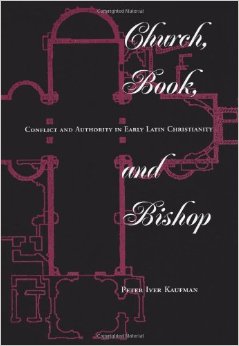
1996 – Christianity took root and grew within a far-flung empire under complicated and widely varying sets of influences. Under these conditions, the problem of establishing doctrinal and institutional coherence and consistency was acute. In this engaging and authoritative book, Peter Kaufman tells a number of stories from the early clerical history of the church to illustrate how authority came to be shared among the institutions of church, book, and bishop.Kaufman offers vignettes drawn from the first seven centuries of Christian clerical life that reflect the struggle to devise management strategies for resolving theological, political, and social conflict. Most accounts of this period emphasize the conflict. This book tells the other side of the story: the work of reconciliation and the efforts of executives to build, repair, and maintain consensus.This is unabashedly a book about elites, for it was on them that the battle against nonconformity and anarchy was thrust. Tertullian and Augustine of Hippo have pride of place, but we also meet Cyprian, Gregory, Ambrose, and others. They were leaders of a very different age, an age that not only shaped Latin Christendom but also left in place the mechanisms for authority, reconciliation, and conflict resolution that characterize Christianity today. Church, Book, and Bishop tells an important story in a way that will appeal to a wide range of readers, including scholars, students, and general readers. It will be especially useful as a supplement to courses on the history of Western civilization, early Christianity, and the early church.
Glenn Hinson: “Kaufman is an engaging writer He has a knack for finding new and fresh words and phrasing, one which would benefit most other historians and elevate interest in their writing.”
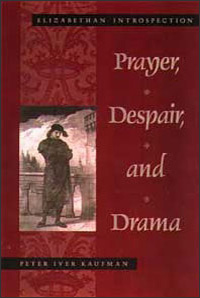
1996 – Prayer, Despair, and Drama explores the godly sorrow and pious dis-ease, or lack of ease, of Elizabethan Calvinists and finds that what some have characterized as an evangelism of fear functioned more as a kind of religious therapy.
In this major contribution to discussions of the relationship between religion and literature in Elizabethan England, Peter Iver Kaufman argues that the soul-searching and self-scourging typical of late Tudor Calvinism was reflected in the rhetoric of self-loathing then prevalent in sermons, sonnets, and soliloquys. Kaufman shows how this spiritual psychology informs major literary texts including Hamlet,The Fairie Queene, Donne’s Holy Sonnets, and other works.
A volume in the series Studies in Anglican History, edited by Peter W. Williams
“Strikingly original and beautifully written….Prayer, Despair, and Drama is an extremely rich, complex study.” – John Corrigan, Arizona State University West
1990 – Peter Iver Kaufman explores how various Christian leaders throughout history have used forms of “political theology” to merge the romance of conquest and empire with hopes for political and religious redemption. His discussion covers such figures as Constantine, Augustine, Charlemagne, Pope Gregory VII, Dante, Zwingli, Calvin, and Cromwell.
“[This book] stands as an impressive series of studies of the church-state relationship. . . . It shows how creative religious leaders have been as they have worked to relate faith to politics in the assurance that the world and the communities of faith cannot exist well in complete separation.” – W. Fred Graham, Journal of the American Academy of Religion
“[An] engaging, ambitious thesis. At a time when the vexed relationship of religion to politics (rightly) occupies so much of our attention it is essential to have such carefully composed historical studies to help us reflect on these critical issues.” – Harvey Cox, Harvard University



 Peter Iver Kaufman